
Cyber Threat Intelligence Is Niet Genoeg. Dit Is Wat Ontbreekt.
Er is een groeiend onderscheid tussen traditionele Cyber Threat Intelligence en Proactieve Threat Intelligence. Dit artikel legt uit wat elk is, hoe ze verschillen en welke aanpak zinvol is voor uw organisatie.
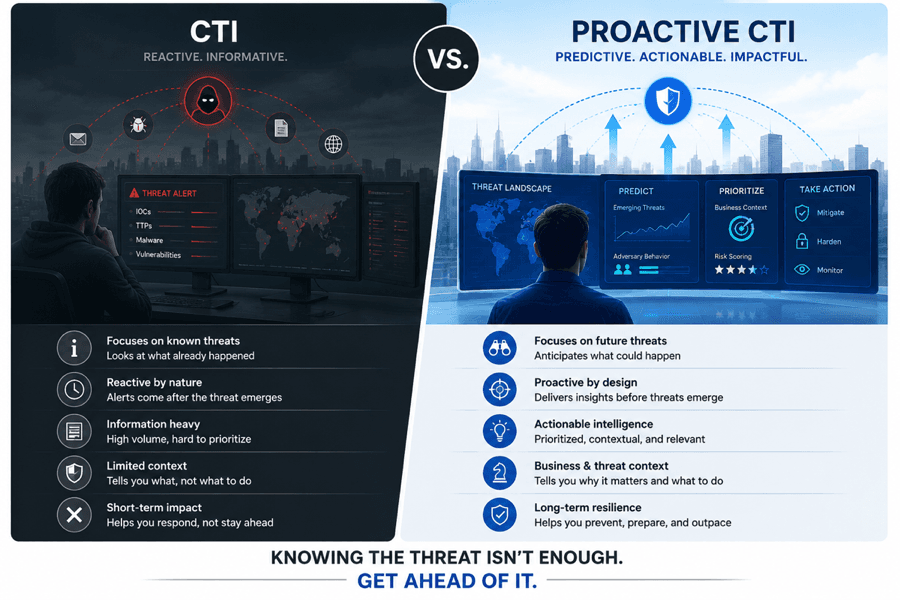
If you work in IT or cybersecurity, you have almost certainly heard the term "threat intelligence." But there is a growing distinction that is worth understanding: the difference between traditional Cyber Threat Intelligence (CTI) and Proactive Threat Intelligence. Both aim to help organizations stay ahead of attackers — but they approach the problem in fundamentally different ways.
This article walks through what each one is, how they differ, and which approach makes sense for your organization.
What Is Cyber Threat Intelligence (CTI)?
Cyber Threat Intelligence is the practice of collecting, analyzing, and acting on information about existing or emerging threats. The goal is to give security teams the context they need to make better decisions: Who is attacking? How do they operate? What are they after?
CTI typically comes in a few forms:
- Strategic intelligence — High-level information about threat actors, their motivations, and geopolitical context. Intended for leadership and decision-makers.
- Tactical intelligence — Details about the techniques, tactics, and procedures (TTPs) that attackers use. Useful for security architects and SOC teams.
- Operational intelligence — Information about specific, ongoing attacks or campaigns — often time-sensitive.
- Technical intelligence — Raw indicators of compromise (IOCs): IP addresses, domains, file hashes, malware signatures.
A Concrete Example
Imagine your security team receives a feed from a threat intelligence platform. The feed reports that a ransomware group called "BlackFog" has been actively targeting manufacturing companies in Europe, using phishing emails with malicious Excel attachments.
Your team uses this information to:
- 1Update your email filtering rules to block .xlsm files from external senders.
- 2Alert employees about the phishing campaign.
- 3Search your logs to see if any similar emails have already landed in inboxes.
This is classic CTI in action. It is reactive by nature — you are responding to threats that have already been observed elsewhere. The intelligence describes what attackers have done or are doing.
The Limitation of Traditional CTI
CTI is genuinely valuable, but it has a structural weakness: it is inherently backward-looking. The information in a threat feed describes threats that have already been identified, weaponized, and often deployed against someone else. By the time an IOC appears in a shared feed, the attackers may have already moved on to new infrastructure.
Think of it like reading yesterday's newspaper to predict today's weather. Useful context, but not the full picture.
What Is Proactive Threat Intelligence?
Proactive Threat Intelligence takes a different approach. Rather than waiting for threats to be observed and reported, it focuses on anticipating threats before they materialize — by understanding attacker behavior, motivations, and likely next moves.
Where traditional CTI asks "What has happened?", proactive threat intelligence asks "What is likely to happen next, and to us specifically?"
This approach involves:
- Attack surface mapping — Understanding what assets you expose to the internet and which of those are most attractive to attackers.
- Threat modeling — Identifying which threat actors are most likely to target your organization based on your industry, geography, and technology stack.
- Dark web and underground forum monitoring — Watching for early signs of targeting: credentials for sale, discussion of your infrastructure, recruitment of insiders.
- Adversary simulation — Actively testing your defenses using the same techniques attackers would use, before they do.
- Vulnerability prioritization based on threat context — Not just "this CVE has a CVSS score of 9.8" but "this CVE is actively being exploited by threat actors who target companies like yours."
A Concrete Example
Using the same manufacturing company from before: instead of waiting for a threat feed to warn them about BlackFog, a proactive threat intelligence programme might look like this:
- 1Attack surface analysis reveals that three internet-facing OT systems are running outdated firmware — the kind of target ransomware groups frequently exploit.
- 2Dark web monitoring finds a post on a cybercriminal forum where someone is offering VPN credentials for "a Dutch manufacturing company" — possibly your organization.
- 3Threat actor profiling identifies that the groups most likely to target your sector are currently experimenting with a new initial access technique involving compromised supplier email accounts.
None of this is a confirmed attack. But it gives your team the opportunity to patch those OT systems, rotate VPN credentials, and alert employees to watch for suspicious supplier communications — before an incident occurs.
The Limitation of Proactive Threat Intelligence
Proactive threat intelligence requires significantly more investment in terms of tooling, analyst expertise, and organizational maturity. It is not a product you can simply plug in — it requires skilled analysts who can interpret signals, model adversary behavior, and translate findings into actionable priorities. For smaller organizations or those with limited security resources, building a full proactive programme can be challenging.
How Do They Compare?
| Cyber Threat Intelligence (CTI) | Proactive Threat Intelligence | |
|---|---|---|
| Orientation | Reactive — describes known threats | Anticipatory — predicts likely threats |
| Primary question | What has happened? | What is likely to happen next? |
| Data sources | Threat feeds, IOC databases, ISACs | Dark web, attack surface analysis, adversary profiling |
| Time horizon | Current and recent threats | Emerging and future threats |
| Output | IOCs, TTPs, incident reports | Risk prioritization, attack scenarios, early warnings |
| Best for | SOC operations, incident response | Security strategy, vulnerability management, red teaming |
| Maturity required | Low to medium | Medium to high |
Which Approach Does Your Organization Need?
The honest answer depends on where you are in your security maturity journey.
- 1If you are still building foundational capabilities — logging, alerting, patching processes, basic security tooling — start with traditional CTI. Integrating a threat intelligence feed into your SIEM or firewall is a relatively low-effort way to improve your defenses with real-world threat data.
- 2If you already have solid detection and response capabilities and want to get ahead of threats rather than just respond to them, proactive threat intelligence is the logical next step. It shifts your posture from reactive to anticipatory — and in an environment where attackers move faster than defenders, that shift matters.
- 3In practice, most mature organizations run both in parallel. The CTI function keeps day-to-day operations informed; the proactive function drives strategic decisions about where to harden defenses, which threat actors to monitor, and how to prioritize remediation.
Summary
- Cyber Threat Intelligence gives you visibility into the threats that exist today and have been observed in the wild. It is essential for any security operation and relatively accessible to implement.
- Proactive Threat Intelligence goes further — it attempts to anticipate threats before they hit you, by understanding your attack surface, monitoring for early signals, and modeling adversary behavior.
- Neither replaces the other. The most resilient organizations treat them as complementary layers of the same intelligence program.
InitiumsTech helps European enterprises build and operationalize their security programs, from DevSecOps integration to threat intelligence strategy. If you want to understand which approach makes sense for your environment, we are happy to have that conversation.
Book a call with our team →